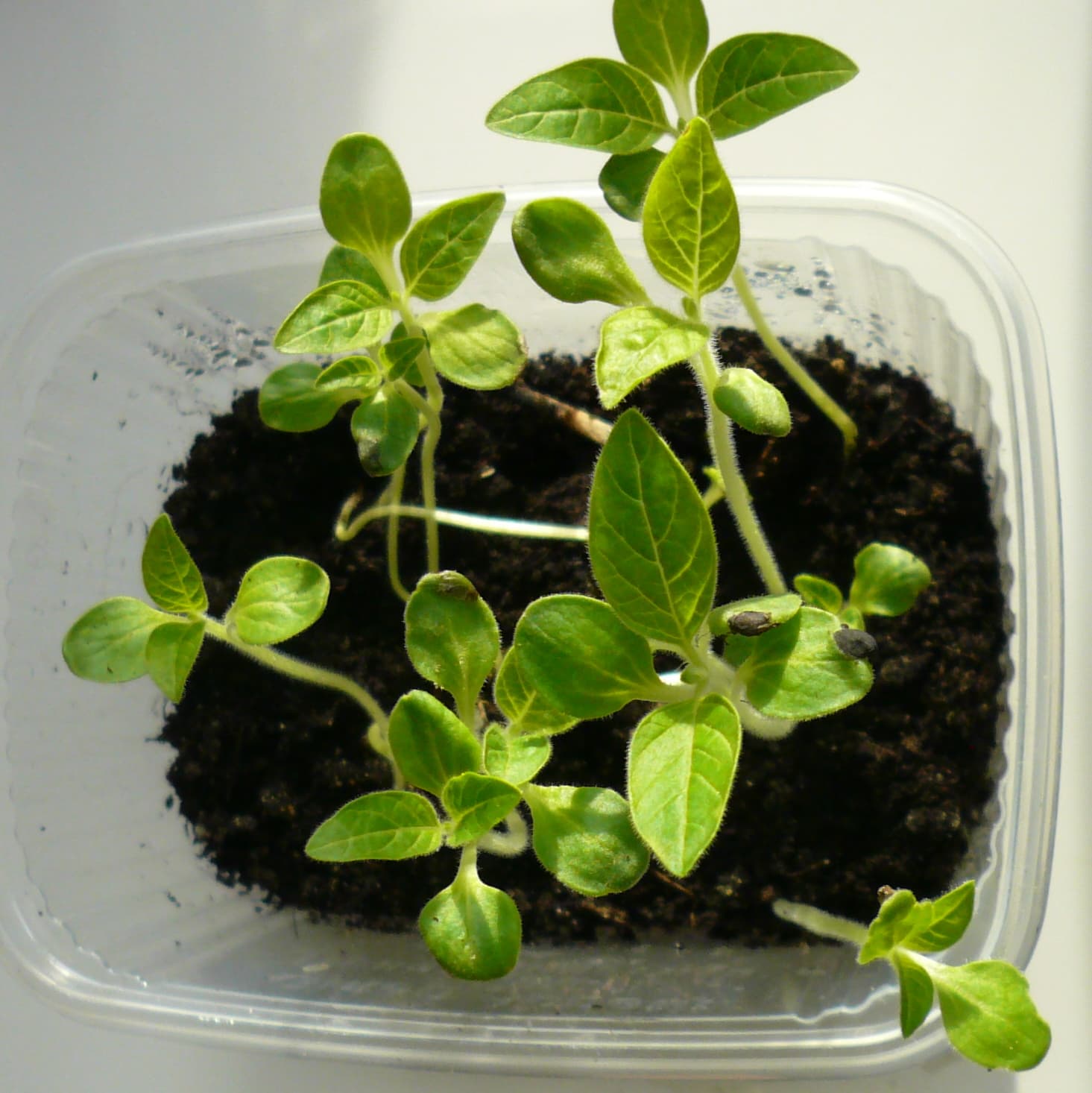
Hydroponic tulsi (Ocimum tenuiflorum) grows with EC 1.2–1.8 and pH 5.8–6.2 at 20–35°C — conditions that match India's ambient climate, making it one of the easiest herbs to grow soillessly without temperature control. Seeds germinate in 7–10 days, first harvest is ready at 5–6 weeks, and the plant yields continuously for months when regularly pinched and harvested before flowering.
How do you sow tulsi seeds for a soilless system?
Tulsi is almost always started from seed rather than cuttings, though stem cuttings root readily in water and can be transferred to a hydroponic system once roots are 3–5 cm long. Seeds are tiny and require no pre-soaking or pre-treatment — they germinate quickly at warm temperatures, making tulsi one of the most forgiving plants for first-time hydroponic growers.
For seed germination, place 4–6 seeds on the surface of a moistened rockwool cube or coco coir plug in a net pot. Tulsi seeds need light and warmth to germinate — do not bury them more than 2–3 mm deep. Cover with a humidity dome or plastic wrap to maintain moisture, and maintain temperature between 25–30°C. At these temperatures, germination occurs in 5–10 days. In Indian summer months (April–July), ambient room temperature is sufficient with no heating required, making indoor tulsi growing particularly accessible.
Three varieties are commonly grown in India, each with distinct characteristics. Rama tulsi (Ocimum tenuiflorum var. tenuiflorum) has green leaves, mild flavour, and the fastest growth rate — ideal for beginners and continuous leaf harvest. Krishna tulsi has dark purple-tinged leaves and a stronger, more peppery flavour with higher eugenol content — slower growing but more medicinally potent. Vana tulsi (Ocimum gratissimum, sometimes called wild tulsi) is the most vigorous and disease-resistant variety, with a clove-like aroma, though it grows larger than the other two and benefits from more space in the system.
How do you nurture hydroponic tulsi through its seedling phase?
Tulsi seedlings are resilient but respond noticeably to nutrient and pH precision. Within the Indian context, where ambient temperatures are naturally warm, the main adjustment for indoor growers is managing light rather than temperature. A south-facing window provides adequate light in summer; in winter or cloudy conditions, a basic LED grow light running 14–16 hours per day ensures consistent growth.
| Parameter | Target Range | Notes |
|---|---|---|
| EC (electrical conductivity) | 1.2–1.8 mS/cm | Start at 0.8 for seedlings; raise to full range at 3 true leaves |
| pH | 5.8–6.2 | Slightly lower than soil-grown tulsi; monitor weekly |
| Temperature | 20–35°C | Broad range suits most Indian climates without AC |
| Light | 14–16 hours/day | Natural light sufficient April–September in most Indian cities |
| Humidity | 50–70% | Avoid stagnant air; use a small fan if growing indoors |
| Water temperature | Below 26°C | Warmer water holds less oxygen; use chilled water if above 30°C ambient |
Nitrogen is the key macronutrient during tulsi's vegetative phase. A standard hydroponic nutrient solution with a moderate nitrogen ratio (roughly 3-1-2 NPK) works well. Tulsi shows nitrogen deficiency as yellowing of older leaves — if this appears, increase EC slightly or switch to a higher-nitrogen formula. Avoid very high EC (above 2.0) as it can cause leaf tip burn and inhibit the aromatic compound synthesis that makes tulsi medicinally valuable.
How do you care for tulsi to keep it productive and bushy?
The most important technique for productive hydroponic tulsi — as with all culinary and medicinal herbs — is consistent pinching. When the main stem reaches 15–20 cm with at least 4 pairs of leaves, pinch out the growing tip just above the second or third node. This redirects growth energy into the axillary buds below the cut, producing two new branches where there was one. Repeat every 10–14 days to build a dense, multi-branching canopy that produces far more harvestable leaf mass than a single tall stem.
Flower spike management is essential for maintaining leaf quality. Tulsi's small white or purple flowers are beautiful and sacred in Hindu ritual, but once a plant enters its reproductive phase, leaf essential oil production declines and the remaining leaves become more bitter. For a medicinal or culinary crop, remove all flower spikes as soon as they appear. You can do this selectively — allow one or two plants in your system to flower if you observe religious practices or want to save seed, while keeping the remainder in continuous vegetative production.
In enclosed growing systems, air circulation prevents two common problems: fungal disease (Botrytis and powdery mildew both affect tulsi in stagnant, humid air) and weak, floppy stems. A small USB fan running at low speed for 12–16 hours a day is sufficient for most home setups. Positioning it so it creates gentle leaf movement — rather than direct strong airflow — produces the mechanical stress response (thigmotropism) that builds stronger, thicker stems.
How do you harvest tulsi and when is the best time?
Tulsi can be harvested on a cut-and-come-again basis from week 5–6 after seeding, continuing for 4–6 months per plant when managed well. The optimal harvest timing is just before the plant shows any sign of flowering — at this stage, essential oil concentration is at its peak, leaves are tender, and flavour is at its most complex and aromatic.
Harvest by cutting stems just above a leaf node pair, removing no more than one-third of the total leaf mass at any single harvest. For fresh culinary use — chai, kadha (herbal decoction), chutneys, or salads — cut in the morning after 2–3 hours of light exposure when volatile compound concentration is highest. For Ayurvedic preparations where dried tulsi is required, harvest entire stems and dry in the shade (not direct sunlight, which degrades volatile oils) at 25–35°C with airflow until leaves are crisp and crumble cleanly.
A well-maintained DWC or NFT-grown tulsi plant will yield 15–30 g of fresh leaf per harvest cycle, with cycles every 10–14 days. Over a 4-month growing season, a single plant can yield 200–400 g of fresh tulsi — the equivalent of dozens of market bundles. After 4–6 months, productivity slows and the plant becomes increasingly prone to bolting; at this point, take stem cuttings to start a new generation and compost the spent plant.
What are the medicinal properties and Ayurvedic significance of tulsi?
Tulsi is classified in Ayurveda as a rasayana — a rejuvenating tonic herb — and as the queen of herbs (Vishnu Priya, beloved of Lord Vishnu). It has been used in Indian medicine for over 3,000 years and remains one of the most clinically studied Ayurvedic plants, with a substantial body of modern pharmacological research supporting many traditional claims.
| Compound | Activity | Traditional Ayurvedic Use |
|---|---|---|
| Eugenol | Anti-inflammatory, antimicrobial, analgesic | Dental pain, respiratory infections |
| Ursolic acid | Anti-cancer (preclinical), anti-inflammatory | General tonic, longevity |
| Rosmarinic acid | Antioxidant, neuroprotective | Memory, cognitive function |
| Ocimarin | Anticoagulant | Circulatory health |
| Camphor, cineole | Expectorant, decongestant | Coughs, colds, asthma |
| Adaptogens (general) | HPA axis modulation, cortisol reduction | Stress, anxiety, immune support |
Clinical evidence supports tulsi's role as a genuine adaptogen: controlled trials show reductions in cortisol, fasting blood glucose, and inflammatory markers with regular consumption of tulsi leaf extract. The Hindu practice of consuming 5–6 fresh tulsi leaves daily in the morning on an empty stomach — a practice followed by hundreds of millions of Indians — is backed by a surprisingly rigorous evidence base for a traditional practice.
Hydroponic tulsi may contain marginally higher essential oil concentrations than field-grown plants, particularly when grown under controlled light and nutrient conditions. The key compounds — eugenol, β-caryophyllene, methyl eugenol — are synthesised in response to light stress and controlled nutrient levels, both of which soilless systems deliver with consistency.