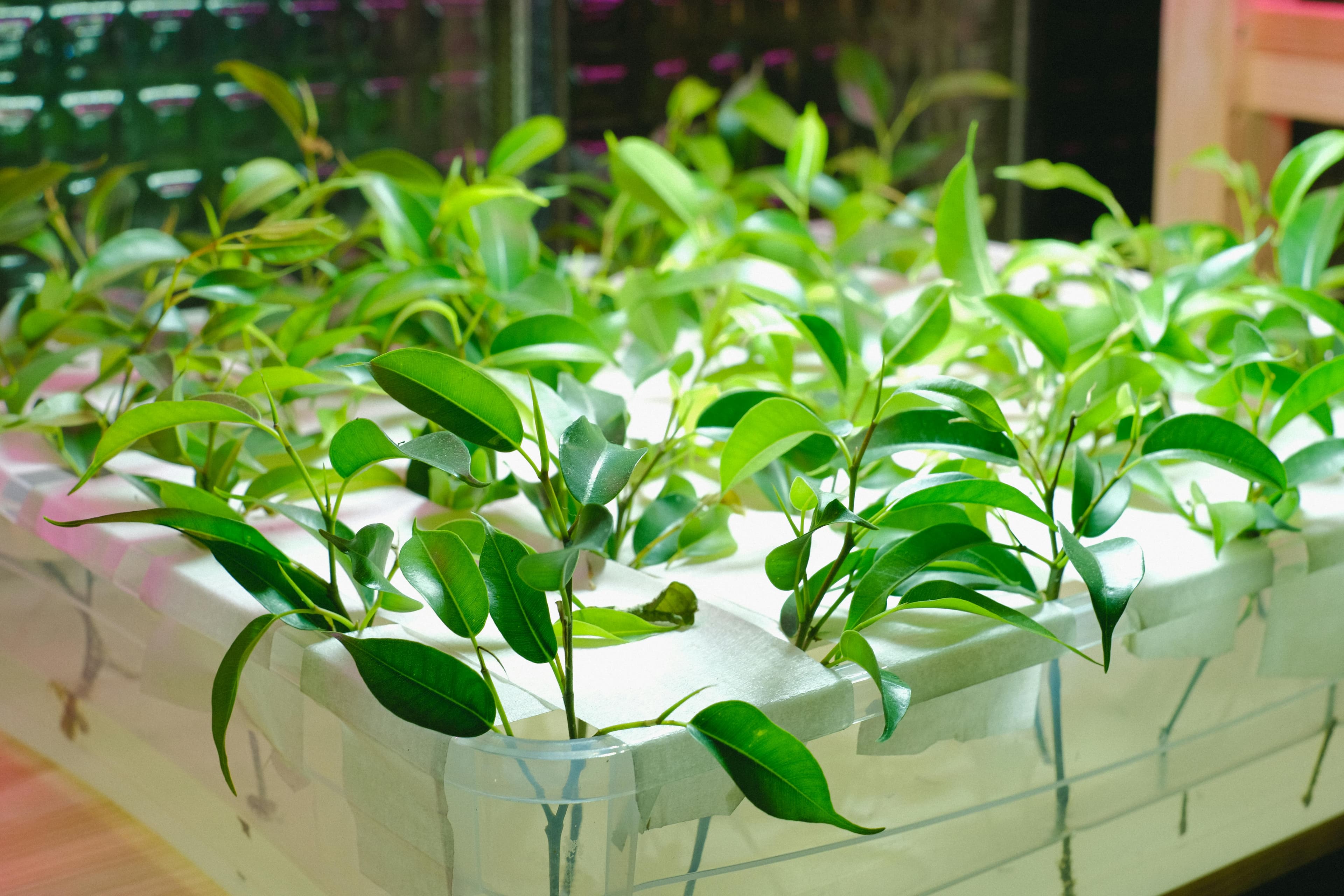
Nutrient Film Technique pumps a thin, continuous stream of nutrient solution along the bottom of sloped channels, bathing the lower portion of roots while the upper roots remain in humid air. This split environment delivers oxygen and nutrients simultaneously, producing exceptional growth rates for leafy crops.
How does the Nutrient Film Technique work mechanically?
NFT systems consist of sloped growing channels — typically shallow PVC gutters or purpose-built square channels — arranged on a frame so that they angle downward at a gradient of 1:30 to 1:40 (roughly 2–3 cm drop per metre of channel length). A submersible pump sits in a reservoir below the channels and pushes nutrient solution continuously up a supply pipe to the upper end of each channel. Gravity draws the solution in a shallow film — no more than 2–3 mm deep — along the channel floor and back down into the reservoir.
Plant roots trail through the channels. The lower portion of each root mat sits in the flowing film, absorbing water and dissolved nutrients directly. The upper portion of the root mass hangs in the humid air pocket above the film, absorbing oxygen freely. This is the defining advantage of NFT: unlike DWC where roots are submerged in oxygenated water, NFT roots access atmospheric oxygen directly, which can be even more effective for certain crops.
Because solution continuously recirculates, NFT is highly water and nutrient efficient. A well-designed system loses almost nothing to evaporation or runoff. The reservoir needs topping up with plain water to replace transpiration losses, and a weekly EC and pH check ensures the nutrient balance stays correct. Compared with run-to-waste drip systems, NFT can reduce nutrient solution consumption by 70–90%.
Channel spacing and length matter significantly. Channels longer than 12 metres can create nutrient gradients — plants near the inlet receive fresher solution while those near the outlet receive depleted solution. Commercial growers either limit channel length or inject additional nutrients mid-channel. Home systems running channels of 1–3 metres rarely encounter this problem.
What equipment do you need to build an NFT system?
The core components of an NFT system are channels, a reservoir, a pump, and pipework. NFT channels are available commercially in 50 mm square, 75 mm round, or 100 mm flat profile. The channel size dictates how many plants fit per metre: 50 mm square channels space lettuce at 20 cm intervals, while larger 100 mm channels accommodate basil, spinach, or chard at 25–30 cm. Deeper channels are needed for crops with larger root masses.
The reservoir should hold at least 10 litres per metre of total channel length. A 3-metre, six-channel system growing 18 lettuce plants needs a minimum 50–60 litre reservoir. Larger reservoirs stabilise pH and EC more effectively and reduce the frequency of adjustments. Use opaque, food-safe containers and drill a drain fitting at the low end to allow complete draining for cleaning.
Pump selection is critical. NFT requires a pump that delivers constant, low-volume flow — approximately 1–2 litres per minute per channel. A pump that delivers too much flow creates a deep pool rather than a thin film, negating the oxygen advantage. Many growers use a submersible aquarium pump (300–600 l/h) controlled with a ball valve to achieve the correct film depth. Test flow rate by running plain water and observing the film depth at the channel's midpoint before introducing plants.
Supporting infrastructure includes a sturdy adjustable frame to set the correct channel slope, end caps to direct flow into return pipes, and a manifold to distribute flow evenly to all channel inlets. Poor manifold design is a common cause of uneven film depth across channels. Use a Y-manifold or multi-outlet header with individual ball valves on each channel to enable fine-tuning.
Which crops perform best in NFT systems?
NFT excels with fast-growing, shallow-rooted leafy crops. Lettuce, spinach, rocket, mizuna, kale, and Asian salad leaves all thrive in NFT channels. These plants have compact root systems that fit comfortably in standard channels and complete harvest cycles in 25–35 days, allowing rapid turnover. Commercial salad producers use NFT almost exclusively because of this efficiency.
Herbs including basil, coriander, parsley, and chives also grow well in NFT, though basil's larger root mass requires 75 mm or 100 mm channels. Chives and spring onions grow particularly well because their fibrous roots never block channels. Avoid mint in shared NFT systems; its aggressive root growth can block channels and contaminate other plants.
Fruiting crops like tomatoes, cucumbers, and peppers present a challenge in NFT. Their extensive root systems can fill and block channels as the plants mature, and their high nutrient demands stress the recirculating solution more rapidly. Expert growers do successfully run tomatoes in wide, deep NFT channels (typically 100 mm × 75 mm or custom gutter profiles), but the system requires more frequent monitoring, larger reservoirs, and supplemental calcium-magnesium dosing. For home growers, DWC or media-based systems are generally more suitable for fruiting crops.
Strawberries occupy an interesting middle ground. Their compact root systems suit NFT channels well, and the combination of high oxygen availability and precise nutrition produces exceptional fruit flavour and yield. Tower-style NFT strawberry systems have become popular in urban farming precisely because they combine high plant density with excellent fruit quality.
What are the most critical failure points in NFT systems?
Power failure is the most dangerous failure mode in NFT. When the pump stops, the thin film drains within seconds, and roots begin drying out within minutes. For short outages of up to 30 minutes, the humid air in channels and residual moisture on roots provides some protection. Outages longer than an hour can cause significant root damage in warm conditions. Serious NFT growers install a UPS (uninterruptible power supply) for the pump circuit or use a battery-operated backup pump.
Channel blockage occurs when root masses grow large enough to dam the flow. Water backs up behind the blockage, flooding part of the channel while the lower section dries out. Inspect channels weekly by shining a torch from the outlet end; if you cannot see through, use a soft brush to clear roots gently. Harvesting on schedule and not allowing plants to overmature is the best preventative measure.
Uneven flow distribution creates winners and losers in the same system. Plants near channels receiving more flow grow faster; those receiving less flow show stress symptoms. Check flow balance when setting up the system using a measuring jug and stopwatch at each channel outlet; aim for flow rates within 10% of each other across all channels.
Pythium and other water moulds can still occur in NFT despite the oxygen-rich root environment, particularly when reservoir temperatures exceed 22 °C or beneficial microbial communities have not been established. Monitor root colour and smell weekly. White, feathery roots indicate health; brown, slimy roots indicate disease. Address temperature first, then consider adding beneficial bacteria.